Your marketing team celebrates 10,000 monthly visitors. Your sales team complains they have nothing to close. Sound familiar?
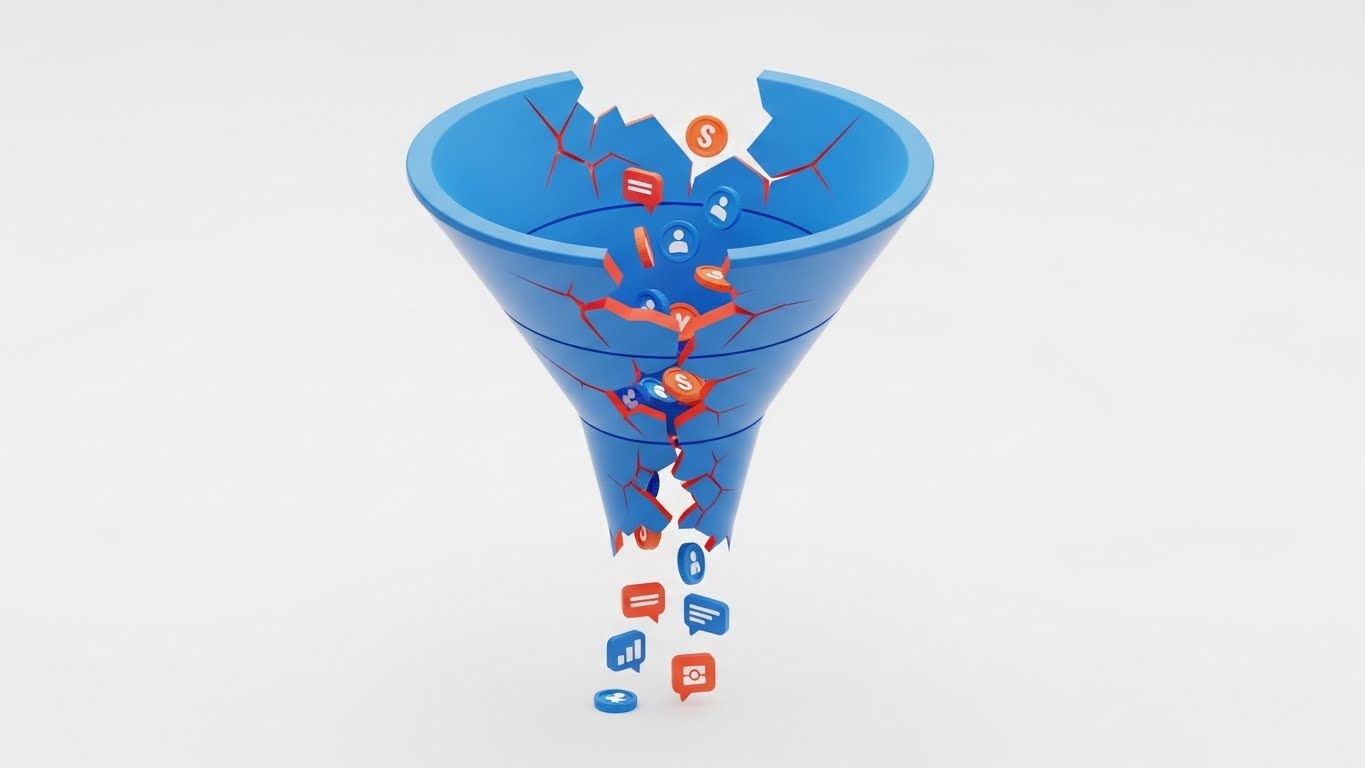
Most businesses blame their funnel problems on the wrong things—traffic volume, ad creative, or landing page design. But here’s the truth: your funnel is working exactly as designed. The problem is it was designed without understanding how buyers actually make decisions.
Let me show you the three critical breakpoints where most funnels fail, with real examples and specific fixes you can implement this week.
Mistake #1: You’re Getting Attention Without Creating Clarity

What’s Actually Happening
Visitors land on your site and leave within 10 seconds. Not because your product is bad, but because they can’t quickly answer three questions:
- Who is this for?
- What problem does it solve?
- Why should I care right now?
Generic messaging might feel safe, but it converts nobody.
Real Example: The $50K Traffic That Generated Zero Sales
A B2B SaaS company spent $50,000 on Google Ads over three months. Traffic jumped 300%. Conversions stayed flat at 0.8%.
Their homepage headline read: “An all-in-one platform to streamline your operations.”
When we asked their target customers what the company did, not one could explain it. Operations for who? Solving what pain?
How to Fix It Right Now
Action Step 1: Rewrite your headline to name one specific problem your ideal customer faces daily.
Bad: “Streamline your operations” Good: “Stop losing leads because your sales team can’t respond fast enough”
Action Step 2: Add “for [specific audience]” in your first 15 words.
Action Step 3: Remove these words from your homepage: innovative, cutting-edge, next-generation, revolutionary, industry-leading.
Clarity Test: Show your homepage to someone unfamiliar with your company for 5 seconds. Ask them to explain what you do. If they can’t, you have a clarity problem, not a traffic problem.
Mistake #2: You’re Building Interest Without Offering Proof

What’s Actually Happening
Some visitors stay longer. They read your features page. They explore your pricing. Then they leave without taking action.
Why? Because claims without evidence create doubt, not confidence.
Real Example: High Engagement, Zero Trust
An IT consulting firm had impressive metrics—3-minute average session time, 4 pages per visit. But demo requests averaged just 2 per week.
Their site featured:
- “Trusted by Fortune 500 companies”
- “Industry-leading cybersecurity solutions”
- “Proven track record of success”
But nowhere on the site could you find:
- Which companies trusted them
- What results they delivered
- How they achieved those results
Visitors were interested enough to explore, but not convinced enough to commit.
How to Fix It Right Now
Action Step 1: Replace vague testimonials with outcome-focused case studies. Use this format:
“[Client name] reduced security incidents by 64% in 90 days after implementing our three-phase audit process.”
Action Step 2: Show your work. Don’t just share results—explain the 3-4 specific actions that led to those results.
Action Step 3: Add proof to every major claim. Making a promise? Show evidence within the same screen view.
Remember: People ignore claims. They believe evidence.
Mistake #3: You’re Capturing Intent Without Building Confidence

What’s Actually Happening
You’ve done the hard work. Visitors are ready to take the next step. They fill out a form or request a demo.
Then everything slows down. Your sales team reaches out 3-5 days later. The prospect has moved on. The opportunity dies.
Small friction at high-intent moments kills more deals than any other funnel problem.
Real Example: The Conversion Killer Hidden in the Calendar
A SaaS company generated 40-50 qualified demo requests monthly. But only 18% became customers.
The problem wasn’t lead quality. It was timing.
When prospects requested a demo, they received an email: “Thanks for your interest! Someone from our team will reach out within 48-72 hours to schedule a time.”
By the time the sales call happened 5-7 days later, 60% of prospects didn’t answer. They’d already chosen a competitor or lost interest.
How to Fix It Right Now
Action Step 1: Reduce response time to under 4 hours. Every hour you wait, conversion rates drop 8-10%.
Action Step 2: Show pricing ranges before the demo request. Hiding pricing creates anxiety, not anticipation.
Action Step 3: Remove unnecessary form fields. Every field you add decreases conversion by 5-10%. Ask only what you need for the first conversation.
Action Step 4: Offer risk reduction—free trial, pilot program, money-back guarantee, or easy cancellation.
The Rule: The closer someone is to buying, the fewer obstacles they should face.
Why Your Funnel Looks Busy But Feels Broken

Here’s what most teams track:
- Website traffic
- Click-through rates
- Form submissions
- Cost per lead
Here’s what they should track:
- Drop-off rates by buyer stage
- Time to first response
- Lead-to-revenue conversion
- Sales team feedback on lead quality
Real Example: The Vanity Metric Trap
A marketing team celebrated their best quarter ever—500 leads generated, 50% above target.
The sales team closed 4 deals.
Marketing blamed sales for “not following up properly.” Sales blamed marketing for “sending junk leads.”
The real problem? The funnel didn’t qualify for intent. Marketing counted every email signup as a lead, including people downloading a generic industry report who had zero buying intent.
How to Fix It Right Now
Action Step 1: Define what “qualified” means with your sales team. Create three categories:
- Aware: Just learning about solutions
- Evaluating: Comparing options actively
- Ready: Need to buy within 30 days
Action Step 2: Build different follow-up paths for each category. Stop treating awareness-stage visitors like they’re ready to buy.
Action Step 3: Track revenue metrics, not just volume. Measure cost per customer, not cost per lead.
Action Step 4: Hold weekly 15-minute funnel reviews with both marketing and sales. Review where deals are getting stuck.
How High-Converting Funnels Actually Work

The best funnels follow a simple three-part rhythm:
Message → Proof → Momentum
Message (Clarity First) Speak to one specific problem your ideal customer faces. Match your content to where they are in the buying process. Use language they actually use, not industry jargon.
Proof (Trust Second) Show real outcomes from real customers. Share specific examples with numbers. Answer objections before they’re asked.
Momentum (Action Last) Make the next step obvious and easy. Respond fast. Remove unnecessary friction. Keep the decision-making process moving forward.
Real Example: Small Changes, Big Impact
A SaaS company made just three changes:
- Changed their headline from “Modern workflow automation” to “Stop wasting 15 hours per week on manual data entry”
- Added one detailed case study showing how a customer saved $120K annually
- Reduced initial response time from 48 hours to 4 hours
No new ad budget. No new tools. No website redesign.
Demo requests increased 34%. Close rate improved from 12% to 23%.
What to Fix First (Before You Spend Another Dollar)
Before investing in more traffic or new technology, complete this checklist:

Your 5-Step Funnel Audit
Step 1: Define your ideal customer in one paragraph. If you’re targeting “everyone,” you’re reaching no one.
Step 2: Map existing content to the three buyer stages (Aware, Evaluating, Ready). Identify gaps.
Step 3: Separate educational content from sales content. Stop selling to people who are still learning.
Step 4: Align marketing and sales messaging. Use the same language, target the same outcomes.
Step 5: Change your success metric from “leads generated” to “revenue influenced.”
Remember: Fix your thinking before you fix your tools.
Final Thought
Your funnel doesn’t need more traffic. It needs better alignment with how people actually decide to buy.
When you respect buyer intent at every stage, conversions follow naturally.
The question isn’t “Why isn’t my funnel working?” The question is “Am I asking people to buy before they trust me, or trust me before they understand me?”
Fix that sequence, and everything else gets easier.
Frequently Asked Questions
Should I redesign my landing page to improve conversions?
Only if your message lacks clarity. A beautiful design won’t save weak messaging. Start with words, not visuals.
How do I identify which stage is causing the problem?
Look at your drop-off data:
- High bounce rate (70%+) = Clarity problem
- Low demo requests despite engagement = Proof problem
- Poor sales conversion despite qualified leads = Confidence or speed problem
Will more traffic solve my conversion problem?
Only if your funnel already converts at 3%+ for cold traffic. Otherwise, more traffic just wastes more money on the same broken system.
How quickly can I see results from funnel fixes?
Clarity and proof improvements often show results within 2-3 weeks. Momentum fixes can impact conversions within days.
Can better tools or automation fix my funnel?
Tools amplify what already works. They won’t fix unclear messaging or lack of proof. Start with strategy, then add tools.
What’s the single biggest mistake companies make?
Treating every visitor like a ready-to-buy customer. Most people need education and trust-building first—respect where they are in their journey.
Ready to fix your funnel? Start with the clarity test. Show your homepage to three people unfamiliar with your company. If they can’t explain what you do in one sentence, that’s your first fix.

Leave a Reply