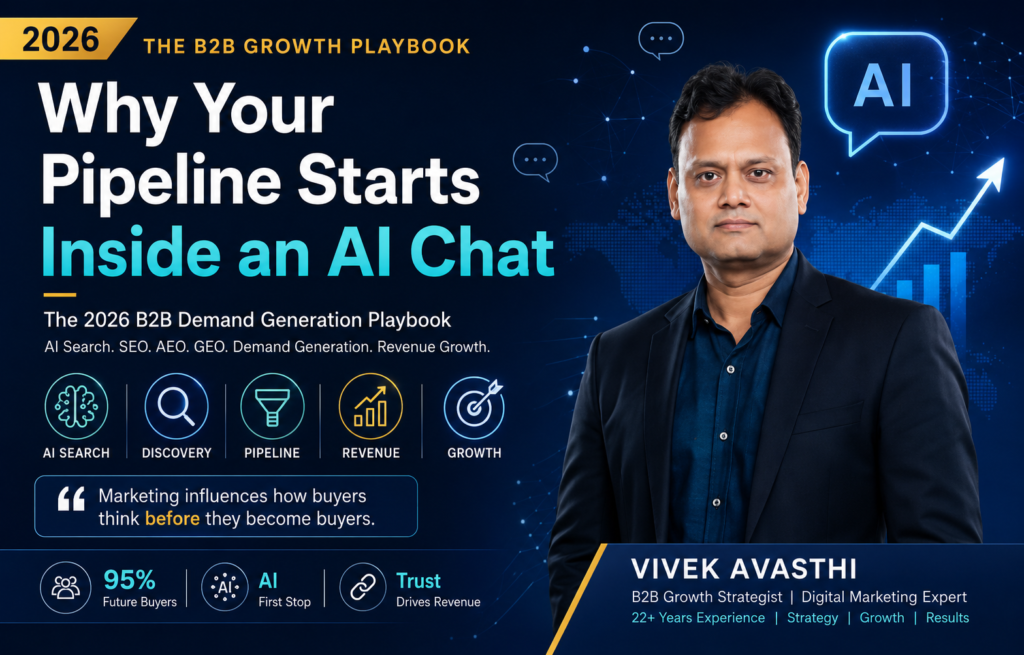

Why Your Pipeline Starts Inside an AI Chat
The 2026 B2B Demand Generation Playbook for CEOs, Founders, CMOs & Revenue Leaders
Part 1 — Why the Playbook Has Changed
Executive Summary
For nearly two decades, B2B marketing followed a familiar formula: generate leads, qualify them, pass them to sales, and close deals. That model worked when buyers depended primarily on Google searches, vendor websites, trade events, and sales conversations to gather information.
Today’s reality is fundamentally different. Modern buyers often begin their journey by asking AI assistants questions, exploring LinkedIn discussions, reading expert content, consulting peers, and comparing vendors before ever speaking with a salesperson. By the time your sales team receives an inquiry, much of the evaluation has already happened.
This shift isn’t simply another marketing trend. It represents a fundamental change in how buying decisions are made. Organizations that recognize it early will build stronger brands, healthier pipelines, and more predictable revenue growth. Those that continue relying solely on traditional lead generation may find themselves competing for an increasingly small pool of active buyers.
This article explores how AI search, Answer Engine Optimization (AEO), Generative Engine Optimization (GEO), demand generation, first-party data, and revenue-focused marketing are reshaping B2B growth in 2026 and beyond.
AI isn’t replacing marketing. It’s changing how buyers discover, evaluate, and trust businesses — long before your sales team knows a buying journey has started.
The Biggest Change in B2B Marketing Isn’t AI — It’s Buyer Behaviour
Technology changes every year. Buyer psychology changes much more slowly. Yet the way buyers discover information has changed dramatically. Instead of waiting for a sales representative to educate them, buyers educate themselves: they compare products, watch demos, read reviews, ask AI assistants, discuss solutions with peers, and validate claims on LinkedIn. Only then do they contact vendors.
This means marketing is no longer responsible for simply generating leads. Marketing now influences how buyers think before they become buyers. That shift changes everything.

Today’s Buyer Journey Is No Longer Linear
The traditional funnel assumed buyers moved through a predictable sequence: awareness, interest, consideration, purchase. Today’s journey is far more dynamic. A founder asks ChatGPT for recommendations. A marketing leader reads a LinkedIn post. A colleague shares a case study. Someone searches Google for validation. The buying committee reviews vendor websites. Procurement requests pricing. And only then does sales join the conversation.
Notice something important: sales enters near the end of the process, not the beginning. Your brand is being evaluated long before your team knows a buying journey has started. This is why educational content and thought leadership have become strategic business assets, not optional marketing activities.
Why This Matters More Than Ever
Imagine two software companies with similar services and experienced teams. The first focuses almost entirely on paid search and outbound prospecting. The second invests in educational content, original research, LinkedIn thought leadership, webinars, customer success stories, and AI-friendly knowledge resources. When a prospect begins researching solutions, which company is more likely to be discovered repeatedly across different channels?
Most buying decisions are not influenced by a single interaction. They are influenced by repeated exposure to helpful expertise. Trust grows through consistency, and demand grows through trust. This is why demand generation has become one of the most valuable investments in modern B2B marketing.

Marketing Is No Longer a Funnel — It’s a Flywheel
Funnels assume customers enter at the top and leave at the bottom. Modern growth behaves differently. Every satisfied customer creates reviews. Every webinar generates content. Every case study builds credibility. Every article improves discoverability. Every LinkedIn post expands reach. Every AI citation reinforces authority. These activities create a continuous loop rather than a one-way process.
Instead of asking, “How do we generate more leads?” leading organizations increasingly ask, “How do we become the company buyers trust before they need us?” That single question changes marketing priorities completely.
From Search Engines to Answer Engines
For years, marketers optimized for one objective: rank higher on Google. That still matters. But buyer expectations have evolved. Instead of typing short keywords, users increasingly ask complete questions — “What is the best CRM for manufacturing companies?”, “Which agency specializes in B2B SaaS demand generation?”, “What is the difference between SEO and GEO?”
These questions are often answered directly by AI assistants before users ever click a website. That means visibility depends on much more than keyword rankings. It depends on becoming a trusted source that AI systems can understand and reference.

The New Visibility Equation
Traditional digital marketing focused primarily on visibility. Modern digital marketing requires visibility and credibility. A useful way to think about it: Visibility + Expertise + Trust = Sustainable Demand. You can buy attention through advertising. You cannot buy trust. Trust is earned through consistent publishing, original insights, customer success stories, practical frameworks, and demonstrated expertise. The companies that invest in these assets today are creating advantages that compound over time.
If someone asked ChatGPT about your industry today, would your company be recommended? Does your content answer real customer questions or mainly promote services? Are you building future demand, or only competing for buyers who are already ready to purchase?
- Buyer behaviour, not just technology, is changing.
- AI is becoming an important discovery channel.
- Marketing influences buying decisions long before sales is involved.
- Demand generation creates long-term competitive advantage.
- Trust compounds through consistent, helpful expertise.
Part 2 — Building an AI-Ready Revenue Engine
Why SEO Alone Is No Longer Enough
For years, digital marketing success was measured by one metric: Google rankings. That approach still matters, but it’s no longer enough. Today’s buyers don’t just search; they ask questions. AI assistants, answer engines, and generative search experiences are changing how information is discovered, and your content now needs to satisfy both human readers and AI systems.
Three complementary disciplines come together here. SEO (Search Engine Optimization) helps people find your content through search engines. AEO (Answer Engine Optimization) structures content to answer specific questions clearly and directly. GEO (Generative Engine Optimization) helps AI models understand, trust, and reference your expertise. Organizations that optimize across all three are more likely to remain visible as search behaviour continues to evolve.
The Shift From Traffic to Trust
Many businesses still chase page views, but traffic alone doesn’t build a pipeline. Consider two companies: Company A receives 100,000 visits but publishes generic, repetitive content; Company B attracts 20,000 highly relevant visitors through original research, practical frameworks, and expert insights. Which is more likely to earn buyer trust? Quality consistently outperforms quantity. The future belongs to organizations that become trusted educators rather than simply content publishers — the type of content people bookmark, share, and reference, and that AI systems are more likely to surface.
Why Most Marketing Funnels Leak Revenue
Marketing teams often celebrate impressive numbers: 50,000 visitors, 2,000 downloads, 1,000 leads, 300 MQLs. But one question is often overlooked: how much revenue did those leads actually generate? A large pipeline at the top doesn’t guarantee growth. Revenue leakage usually comes from poor lead qualification, weak follow-up, marketing-sales misalignment, generic messaging, low buyer intent, and a lack of trust during evaluation. Modern leaders focus less on lead volume and more on pipeline quality.

Demand Capture vs. Demand Creation
One of the biggest mistakes in B2B marketing is relying exclusively on demand capture — targeting buyers already looking for a solution through paid search, demo requests, comparison pages, and high-intent keywords. These are essential, but they reach only a small percentage of the market. Demand creation reaches everyone else through educational content, executive thought leadership, original research, industry reports, podcasts, webinars, LinkedIn insights, and community engagement. Demand capture wins today’s opportunities; demand creation builds tomorrow’s pipeline. The strongest organizations invest in both.

Building Topical Authority
Publishing hundreds of unrelated blog posts no longer works. AI systems and search engines increasingly reward organizations that demonstrate deep expertise within a specific domain. Instead of covering every topic, focus on becoming the recognized authority in a few strategic areas. If your expertise is B2B demand generation, build comprehensive content around buyer behaviour, AI search, SEO, AEO, GEO, revenue marketing, ABM, pipeline growth, and first-party data. Every article should strengthen the next, so your content becomes a connected knowledge hub rather than a collection of isolated posts.
The AI Visibility Pyramid
Visibility doesn’t begin with rankings; it begins with value. Companies that consistently educate their audience build experience, then helpful content, then authority, then trust, then pipeline, and finally revenue. Notice that revenue sits at the top, not the bottom — it’s the outcome of a well-designed system, not a standalone objective.

Marketing Is Becoming a Revenue Function
The role of marketing has expanded significantly. It is no longer responsible only for website traffic, social engagement, and lead generation. Today’s marketing teams are expected to influence pipeline creation, revenue growth, customer retention, expansion, brand preference, and AI discoverability. This requires stronger collaboration between marketing, sales, customer success, and product. Growth is no longer achieved through isolated campaigns; it comes from connected systems working together.
- SEO remains important, but AEO and GEO are becoming equally valuable.
- Trust is becoming a stronger advantage than traffic alone.
- Measure success by pipeline and revenue, not just lead volume.
- Demand capture and demand creation serve different but complementary purposes.
- Topical authority increases discoverability for both people and AI.
- Long-term growth comes from connected knowledge ecosystems.
Part 3 — Preparing for the AI-First Future of B2B Growth
The Future Belongs to Businesses That Own Their Data
For years, marketers relied heavily on third-party cookies, purchased databases, and external intent signals. That approach is becoming less effective as privacy regulations evolve, browser restrictions increase, and buyers become more selective about sharing information. As a result, first-party data has become one of the most valuable business assets.
First-party data includes information collected directly from your audience: website interactions, CRM records, product usage, webinar registrations, email engagement, support conversations, survey responses, and community participation. Unlike third-party data, it is accurate, permission-based, and unique to your business. Companies that collect and use it responsibly will deliver more relevant experiences, make better decisions, and improve AI-driven personalization.

AI Agents Will Influence More Buying Decisions
The next evolution of AI goes beyond answering questions. AI agents are beginning to compare vendors, summarize proposals, review documentation, evaluate pricing, assist procurement teams, and recommend solutions. This changes an important assumption: your content will soon be read not only by people but also by intelligent systems acting on behalf of buyers.
To prepare, publish well-structured content, explain concepts clearly, use evidence to support claims, share real-world experience, and build topical authority. Content that is easy for people to understand is usually easier for AI systems to interpret as well.

If an AI assistant compared your company with three competitors today, would your expertise stand out?
The Modern Revenue Engine
Many organizations still treat marketing, sales, and customer success as separate functions. High-performing businesses don’t. They build an integrated revenue engine where each function strengthens the next: valuable content feeds SEO, AEO and GEO, which build AI visibility and thought leadership, which earn buyer trust, which powers demand generation, sales conversations, customer success, advocacy, and expansion revenue. Each stage reinforces the next, and over time the system becomes more efficient because trust compounds.

A 90-Day Action Plan
Reading about change is useful; implementing it creates results. If I were advising a B2B organization today, these would be my priorities for the next 90 days.
- Month 1 — Build the foundation: audit existing content, identify core topics, create a topical authority map, improve technical SEO, and review analytics and conversion tracking.
- Month 2 — Improve AI visibility: rewrite key pages using answer-first formatting, publish practical experience-based articles, add FAQs and structured content, strengthen internal linking, and refresh older content.
- Month 3 — Build demand: publish LinkedIn thought leadership consistently, launch a monthly webinar or newsletter, create original research, build executive case studies, and measure pipeline influence instead of only leads.
Small, consistent improvements often outperform large one-time campaigns.
Executive Growth Checklist
Before finalizing your strategy, run through this checklist across strategy, content, AI readiness, data, measurement, and leadership.

Frequently Asked Questions
Is SEO still important?
Absolutely. SEO remains the foundation of digital visibility. However, combining it with AEO and GEO improves your chances of being discovered through both traditional search and AI-powered experiences.
What is AEO?
Answer Engine Optimization focuses on creating content that provides direct, accurate, and easy-to-understand answers to user questions.
What is GEO?
Generative Engine Optimization helps AI systems understand, trust, and reference your content when generating responses.
Should businesses stop investing in lead generation?
No. Lead generation remains essential. The opportunity is to balance demand capture with demand creation so you generate results today while building a stronger pipeline for tomorrow.
How often should organizations publish thought leadership?
Consistency matters more than volume. One high-quality, experience-based article each week will usually deliver more long-term value than several generic posts.
Final Thoughts
Technology will keep evolving. Algorithms will change. New AI tools will emerge. But one principle remains constant: businesses that educate, build trust, and solve real customer problems will always outperform those that simply promote themselves. The companies that succeed over the next decade won’t necessarily have the biggest advertising budgets — they will be the most trusted source of knowledge in their industry.
AI is changing how buyers discover information. It is not changing what buyers ultimately value. They still choose partners they trust. Trust is built through expertise, expertise is demonstrated through helpful content, and helpful content creates sustainable business growth. That is the opportunity in front of every B2B organization today.
- AI is reshaping how buyers research and evaluate solutions.
- SEO, AEO, and GEO work together to improve discoverability.
- Demand creation builds future pipeline; demand capture converts existing demand.
- First-party data is becoming a strategic asset.
- AI agents will increasingly influence purchasing decisions.
- Revenue growth comes from integrated systems, not isolated activities.
- Organizations that consistently educate their market earn lasting trust.
How is your organization adapting to AI-driven buying behaviour? Are you optimizing for AI search as well as traditional search? Which strategy from this playbook will you implement first? Share your perspective — let’s learn from each other.
Message me on LinkedIn or visit vivekavasthi.com for the free Pipeline Leak Audit.
Sources & further reading: Ehrenberg-Bass Institute (95:5 buyer research); Gartner (B2B buying journey, agentic AI); Forrester (demand generation & revenue waterfall); 6sense (buyer behaviour); Google & BCG (first-party data); EMARKETER (AI search adoption); ITSMA (ABM).

Leave a Reply