I remember when SEO was straightforward.
Find the right keywords. Build backlinks. Wait for Google to rank you. That was the entire playbook.
I spent the early years of my career helping businesses climb search rankings using exactly that approach. It worked consistently. Traffic came. Leads followed.
That world no longer exists in its original form.
Today I work with B2B companies, SaaS founders, and service businesses across multiple markets. And the most dangerous assumption I encounter, week after week, is this.
If we rank on Google, we are winning at search.
That was true in 2015. In 2025 it is only one third of the truth.
What Is the New Search Landscape in 2025?
Search is no longer a single destination.
People are finding answers through Google’s AI Overviews, through ChatGPT, through Perplexity, through Gemini, through voice assistants, and through answer boxes that never send traffic to your website at all.
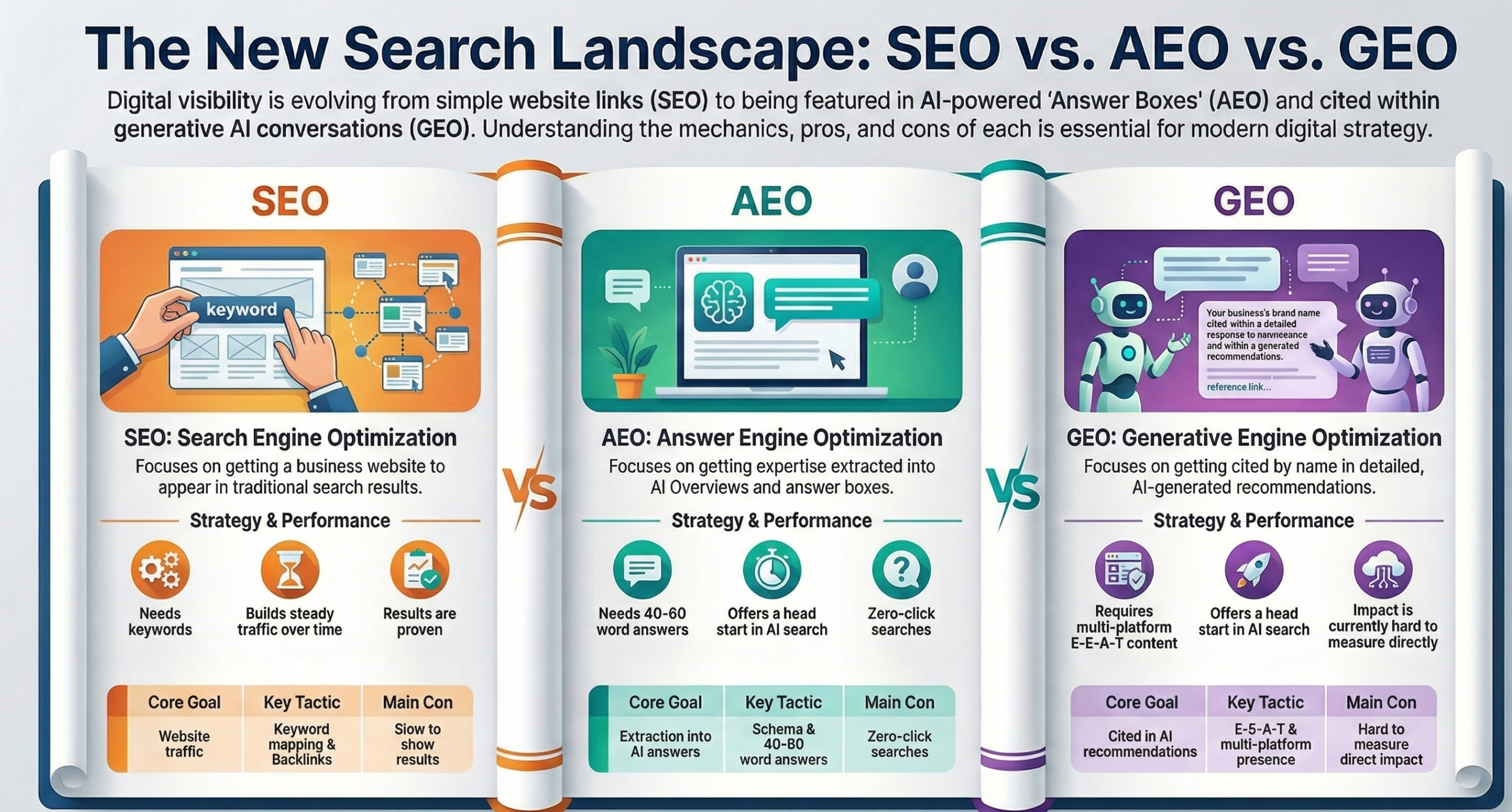
The game has split into three distinct disciplines.
- SEO: Search Engine Optimization
- AEO: Answer Engine Optimization
- GEO: Generative Engine Optimization
Each one requires a different strategy. Each one rewards a different kind of content. And each one is currently at a different stage of maturity.
Here is what every marketer needs to understand about all three.
What Is SEO and Does It Still Work in 2025?
SEO is the practice of getting your website to appear in traditional search engine results pages. When someone types a query into Google and clicks a blue link, that is SEO at work.
How SEO Works
- Keyword research to identify what your audience is actively searching for
- On-page optimization of content, headings, and metadata
- Technical SEO covering site speed, crawlability, and mobile structure
- Backlink building to establish domain authority and topical trust
- Consistent content creation around target topics and search intent
What SEO Does Well
- Builds compounding organic traffic that grows over time
- Drives qualified visitors with clear purchase intent
- Delivers measurable ROI that improves with content age
- Works across every industry, market, and business size
Where SEO Falls Short
Results take time. Three to six months is realistic for most campaigns. In competitive markets it can take considerably longer. And with Google increasingly answering questions directly on the results page, some traffic that SEO used to deliver simply no longer exists in the same volume.
SEO is still non-negotiable. But it is no longer sufficient on its own.
What Is AEO and Why Does It Matter Right Now?
AEO, or Answer Engine Optimization, is the practice of structuring your content so it gets extracted and displayed inside Google’s AI Overviews, featured snippets, and answer boxes directly on the search results page.
When someone searches “what is the best way to generate B2B leads” and Google answers the question before showing any links, that answer came from a website that optimized for AEO.
How AEO Works
- Writing concise, direct answers to specific questions in 40 to 60 words
- Using structured data and schema markup to help Google understand content
- Creating FAQ sections that mirror how people actually phrase questions
- Organizing content around question and answer formats throughout
- Building topical authority around a clearly defined subject area
What AEO Does Well
- Gets your content in front of users even when they do not click through
- Builds brand awareness at the top of the search results page
- Positions your business as the authoritative source on a topic
- Gives you a meaningful head start in AI-powered search environments
Where AEO Falls Short
Zero-click searches are the main trade-off. When Google answers the question on the page, users often do not visit your website at all. AEO builds visibility and authority but does not always translate directly into traffic or immediate leads.
That said, the brands appearing in AI Overviews are being seen. The brands not appearing are becoming invisible. In 2025 that distinction matters more than most marketers realize.
What Is GEO and How Is It Different From SEO and AEO?
GEO, or Generative Engine Optimization, is the practice of building your brand presence so that AI tools like ChatGPT, Perplexity, Gemini, and Claude cite, recommend, or mention you when users ask relevant questions.
When someone opens ChatGPT and asks “who is the best digital marketing consultant for B2B SaaS companies in India,” which names appear? That outcome is shaped by GEO.
How GEO Works
- Building consistent E-E-A-T signals across your website, LinkedIn, and third-party publications
- Getting cited in authoritative articles, directories, and media outlets that AI models reference
- Publishing long-form thought leadership content that demonstrates genuine, first-hand expertise
- Maintaining a consistent point of view that AI systems can associate with your name and niche
- Being active across multiple platforms so your authority signals are broad and reinforcing
What GEO Does Well
- Positions you as a recommended expert inside AI-generated conversations
- Builds brand authority that compounds across platforms over time
- Works across every major AI platform simultaneously when executed correctly
- Creates competitive separation that is very difficult for competitors to replicate quickly
Where GEO Falls Short
Measuring direct impact from GEO is genuinely difficult right now. There is no clean GEO ranking report or traffic attribution dashboard available. You are building for a channel that is already delivering results but not yet fully measurable with standard tools.
The marketers investing in GEO today are making a calculated bet. Based on what I am seeing across my own presence and my clients’ results, it is a bet worth making early.
Why Most Businesses Are Getting This Wrong
Here is the pattern I see consistently across the businesses I work with.
They have a mature SEO strategy. Rankings are tracked. Content is published. Links are being built. That part is often well managed.
But they have no AEO strategy. Their content is written in long, dense paragraphs that AI systems cannot extract cleanly. There is no schema markup in place. Nothing is structured to answer a specific question directly.
And they have no GEO strategy at all. They are not building multi-platform authority. They are not getting cited in relevant publications. They are not showing up in AI-generated recommendations in their category.
Meanwhile their competitors, often smaller and less established, are quietly building AEO and GEO presence. Those competitors are starting to appear in AI Overviews and generative engine responses while bigger, more established brands remain completely invisible in those channels.
This is not a hypothetical future scenario. It is happening right now in every industry I work in.
How I Rebuilt My Own Digital Strategy Around All Three
Over the past year I rebuilt my own digital presence around SEO, AEO, and GEO simultaneously.
My SEO approach
Maintained consistent keyword-led content on vivekavasthi.com targeting B2B marketing, demand generation, and SaaS growth topics. Kept technical foundations clean and continued building topical authority through long-form content.
My AEO approach
Rewrote key pages and articles to include direct 40 to 60 word answers at the top of each section. Added FAQ schema across highest-traffic pages. Restructured content to directly answer specific questions my audience is actively searching for in Google.
My GEO approach
Increased publishing frequency on LinkedIn. Contributed to third-party publications in my niche. Focused consistently on building topical authority around B2B digital marketing, SEO strategy, AEO, GEO, and SaaS growth. The goal was to create enough authoritative signal that AI systems would begin associating my name with these topics reliably.
The results have been gradual but clear. Content is appearing in AI Overviews. My name is surfacing in AI-generated recommendations in my area of expertise. The compounding effect of all three working together is meaningfully different from SEO alone.
The Practical Framework: What to Do Right Now
Step 1: Audit your current content
Look at everything you have published. Is it optimized for traditional search only? Does it include direct answers to specific questions? Are you being cited anywhere outside your own website?
Step 2: Build for all three in parallel
- Continue your SEO work without interruption
- Add a direct 40 to 60 word answer section to every new piece of content
- Structure FAQ content with FAQ schema markup on key pages
- Increase publishing presence on LinkedIn and relevant third-party platforms
- Seek guest contributions, podcast appearances, and media mentions consistently
Step 3: Measure what you can
- Track organic traffic and keyword rankings for SEO
- Monitor which pages appear in AI Overviews for AEO signals
- Search for your brand name in ChatGPT, Perplexity, and Gemini regularly to track GEO presence
Step 4: Think in realistic time horizons
- SEO delivers compounding results in 3 to 6 months
- AEO can show results in 4 to 12 weeks with proper schema and structured content
- GEO is a 6 to 18 month authority-building play that rewards consistency
SEO vs AEO vs GEO: Quick Comparison
Primary goal
- SEO: Website traffic from traditional search
- AEO: Extraction into AI answer boxes and featured snippets
- GEO: Brand citation in AI-generated recommendations
Core tactic
- SEO: Keyword mapping and backlink building
- AEO: Schema markup and 40 to 60 word structured answers
- GEO: Multi-platform E-E-A-T content and authority building
Result timeline
- SEO: 3 to 6 months
- AEO: 4 to 12 weeks
- GEO: 6 to 18 months
Main challenge
- SEO: Slow to show results in competitive markets
- AEO: Zero-click searches reduce direct traffic
- GEO: Impact is currently hard to measure directly
Best used for
- SEO: Building long-term organic traffic
- AEO: Owning position zero and AI Overview slots
- GEO: Becoming the recommended expert in your category
Frequently Asked Questions
What is the difference between SEO, AEO, and GEO?
SEO gets your website to appear in traditional Google search results through keyword optimization and backlinks. AEO structures your content to be extracted into Google’s AI Overviews and answer boxes. GEO builds your brand authority so AI tools like ChatGPT and Perplexity recommend or cite you in their generated responses. All three serve different channels and require different execution strategies.
Is SEO still relevant in 2025?
Yes. SEO remains the foundation of any digital marketing strategy. It drives qualified organic traffic, builds long-term domain authority, and supports both AEO and GEO efforts. The difference in 2025 is that SEO alone is no longer sufficient. Businesses need all three disciplines working together to maintain full search visibility.
What is AEO and how do I optimize for it?
AEO stands for Answer Engine Optimization. It involves structuring content to appear in Google’s featured snippets and AI Overviews. To optimize for AEO, write direct answers to specific questions in 40 to 60 words, implement FAQ schema markup, organize content in a clear question and answer format, and build topical authority in your niche.
What is GEO in digital marketing?
GEO stands for Generative Engine Optimization. It is the practice of building brand authority and multi-platform presence so that generative AI tools like ChatGPT, Perplexity, and Gemini cite or recommend your business when users ask relevant questions. GEO is built through consistent thought leadership, E-E-A-T content, third-party citations, and cross-platform authority signals.
How long does it take to see results from AEO and GEO?
AEO results can appear in 4 to 12 weeks when content is properly structured with schema markup and direct answers. GEO is a longer play, typically requiring 6 to 18 months of consistent authority building across multiple platforms before reliable citation patterns emerge in generative AI tools.
Can a small business compete with larger brands in AEO and GEO?
Yes, and this is one of the most significant opportunities in 2025. AEO rewards content quality and answer structure, not domain authority alone. GEO rewards genuine expertise and consistent publishing, not budget size. Many smaller, more focused businesses are currently outranking larger competitors in AI-generated responses simply because they started building authority earlier and more consistently.
What is E-E-A-T and why does it matter for GEO?
E-E-A-T stands for Experience, Expertise, Authoritativeness, and Trustworthiness. It is Google’s framework for evaluating content quality and is also the primary signal that generative AI tools use to determine which sources to cite. Building strong E-E-A-T requires publishing content based on real first-hand experience, getting cited by authoritative third-party sources, maintaining a consistent and credible online presence, and demonstrating genuine subject matter expertise over time.
How do I measure GEO performance?
GEO measurement is still evolving. Practical approaches include regularly searching for your brand and key topics in ChatGPT, Perplexity, and Gemini to track whether you are being cited, monitoring referral traffic from AI tools in Google Analytics, tracking branded search volume growth over time, and measuring the frequency and quality of third-party citations in your niche. Dedicated GEO measurement tools are emerging but none yet offer the maturity of traditional SEO analytics platforms.
Should I prioritize SEO, AEO, or GEO if I have a limited budget?
Start with SEO as the foundation since it supports both AEO and GEO indirectly. Then layer in AEO by restructuring existing content with direct answers and schema markup, which requires effort more than budget. Invest in GEO through consistent LinkedIn publishing and thought leadership, which again is more about time and expertise than spend. All three can be built simultaneously without large budgets when the strategy is clear.
What type of content works best for GEO?
Long-form thought leadership articles that demonstrate first-hand expertise work best for GEO. Content should include specific, experience-based insights rather than generic advice. Original research, case studies, and frameworks tied to your name perform particularly well. Being cited by other credible publications in your niche amplifies GEO signals significantly. Consistent publishing over time matters more than volume.
The Simple Truth
The marketers who will lead their categories over the next three years are not the ones with the biggest ad budgets.
They are the ones who understood early that search had changed, adapted their strategy across all three disciplines, and built authority before their competitors noticed the shift.
SEO got you here. AEO keeps you visible. GEO makes you the recommended answer.
All three working together is where sustainable digital authority lives in 2025 and beyond.
The question is not which one to focus on.
The question is how fast you can get all three working simultaneously.
About the Author
Vivek Kumar Avasthi is a digital marketing professional with 20 plus years of experience specializing in SEO, AEO, GEO, B2B lead generation, and demand generation for B2B SaaS and IT companies. He advises businesses across India, the US, UK, UAE, and Southeast Asia on building scalable, future-ready digital marketing systems.

Leave a Reply